
MANAGERS GUIDE
How to Trap a Thief
This exclusive, step-by-step managers guide to trapping a thief will explain how to devise, prepare and execute a thief trap from conception to conclusion and provides simple directions for the correct use of the products you have purchased. It has been written to describe the use LUVINOL™ UV Forensic Smart Gel to trap a thief or miscreant.
LUVINOL is a newly developed clear coating which on contact with human skin, will leave an invisible UV stain for up to 24 hours (more about this at the end of this guide).
It aims to offer inspired ideas and suggestions based on the LUVINOL’s unique characteristics, to help you devise you own solution, and implement it in a discreet and professional manner.
It will cover….
1. How to obtain ‘Proof of Contact’ to identify the thief.
2. How to prepare, bait and test your trap.
3. How to proceed once your trap has been sprung!
Whist this article covers the process of setting a trap for a thief, it is just as relevant to identifying someone responisible for tampering with alarm panels, machinery, safety equipment or production control equipment etc.
EMPLOYEE THEFT is generally defined as…
“Any stealing, use or misuse of an employers assets without permission.”
Who is stealing my Cookies?

Let’s consider a simple hypothetical scenario we’ll call: “Who is stealing my cookies?”
Yes its simple, but it will serve nicely to illustrate the principle of a simple ‘thief trap’.
A small company provides a small communal office kitchen shared by several employees.
One of the employees is stealing cookies from a personal cookie jar belonging to another employee! However, the cookie jar is in a shared-use cupboard located in the shared-use kitchen.
The obvious problem here, is that all the office staff have a legitimate right-of-access to both the kitchen and the cupboard, so there is little point in setting a thief-trap on anything beyond the cookie jar itself.
But wait, it’s also possible that a colleague might innocently pick up the cookie jar to move it aside to access something else! So we cannot simply coat the outside of the jar with LUVINOL, as this could lead to one (or more) false-positives!
Therefore, the only sensible option here would be to apply LUVINOL to the actual LID of the cookie jar, as this would only be physically gripped if you wanted to open up the jar and take out a cookie yes?
Taking this approach takes account of legitimate access to the kitchen and cupboard, as well as some innocent handling of the jar itself. However, only when the culprit attempts to ‘open’ the jar is the trap sprung and their hands invisibly (and secretly) stained by the LUVINOL coating, thus providing you with indisputable proof-of-contact between the suspect and the cookie jar lid. So now, once you have checked the hands of staff with a UV Forensic Torch, you will have the identity of the thief.
In this simple scenario it was only cookies taken, however it could just have easily been the theft of petty cash, removal of items from a colleague’s handbag or purse, theft or substitution of stock items or even the taking of medicines from a cabinet. The principle is much the same.
Naturally, your problem will be far more serious than a few missing cookies and you’ll be wanting to set a trap to catch your thief. However, before you begin you must consider carefully the nature bait that will serve to trap them i.e. your ‘cookie jar’. Read on for helpful tips and suggestions on how to achieve this…
Setting the trap properly

Setting a trap to catch a thief or other miscreant needs careful consideration to avoid the embarrassing complications of trapping an innocent person and missing the real suspect!
Here are a few suggestions to consider…
Assuming you have good idea (or suspicion) of who the miscreant is, determine the suspect’s movement patterns and working practices, so you know WHEN the suspect will be in position to take the bait you have prepared. There is no point in setting a trap if the suspect is on a different shift or even on holiday!
Make sure the bait (your ‘cookie jar’) is not too easily accessible so as to tempt a passing opportunist. The bait needs be purposefully sought-out and a clear attempt made to access it i.e. having the cookie jar out-of-sight inside a cupboard, not left out on show.
Tip: If the bait being used is ‘Cash’ it would be wise to use an invisible UV marker pen to write your business-name and date on each banknote. This way the suspect cannot claim the cash was in their possession when they came to work. This can also apply to other common valuables and non-company specific stock items.
Tip: If UV marking electrical items or the like, place the UV mark ‘out of sight’ i.e. inside a battery compartment or similarly concealed location. Consider marking other ‘baitable’ items (which may plausibly be brought onto the company premises by an employee and that are the same as company held stock items, that could thereby be covertly switched or stolen ie: substitution theft.
Set the trap so it can be sprung in as short a time frame as possible. Do not set a trap and leave it unchecked for several hours! Ideally you’ll have a good idea who your suspect is and a good idea when they are likely / able to strike so set your trap accordingly.
Be in position to make regular, discreet checks to see if the trap has been sprung (ie: any missing cookies?). The quicker the process is completed the less chance the suspect will have to make-up a plausible excuse or leave the premises!
One more thing, test the trap First! Be sure to do a discreet, mock run-through and make sure there will be sufficient LUVINOL on the suspect’s hands to categorically demonstrate that actual contact has been made and a theft has occurred.
OK. Trap sprung. Now what?
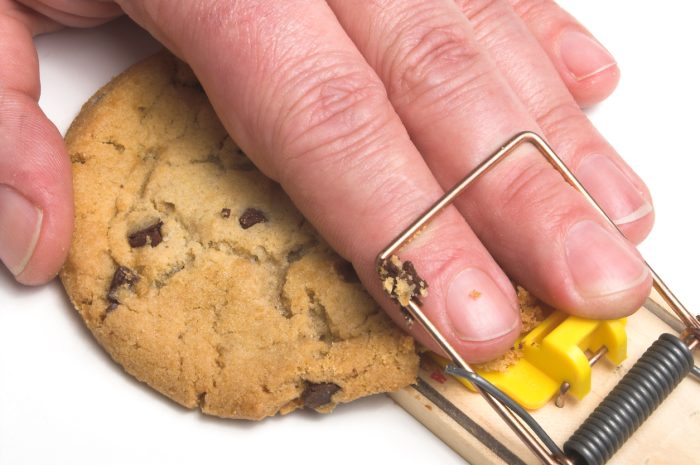
Once you have quickly determined that the trap has been sprung, and you are absolutely certain the you have the right person. Great!
But what if you are still not sure who it was! How do you now check all your suspects to see who was the one responsible? How do you go about that? Well, discreetly, and in such a way that if you have got it wrong, all the suspects would be none-the-wiser, and the search for the true miscreant could continue unabated.
To this end you may need to come up with a plausible and believable reason for asking staff to show you their hands so you can shine your UV Forensic torch on them without raising any suspicion.
One idea could be a random ‘Hand Hygiene Check‘? A quick visual inspection of the hands under a special UV light, in order to reveal the state of ‘cleanliness’ of their hands by revealing any ‘germs’ or ‘contamination’ present on them.
Note: People outside of the Medical and Healthcare sectors are unlikely to know this is not actually true (germs do not show up under UV light!) so it should work well for most working environments. Those within healthcare sectors will already be familiar with the concept, that it will probably not be out place to be asked as part of a hygiene audit.
After recent health scares and pandemic, hand hygiene has been high on the public agenda, so it’s believable that there could indeed be new guidelines to encourage staff to be more conscious of their hand hygiene. After all, from an employee’s perspective, this may be just the sort of thing management might come up with. Right?
Consider mentioning to staff a few days before you intend to set your trap, to explain that the C.Q.C (or relevant standards body) is conducting a survey of ‘Workplace Hand Hygiene’ and that your department / company is taking part. No big deal. A few random checks, that’s all.
If your suspect works in a communal work environment, you may have to check the hands of a few colleagues first, just so the suspect will themselves expect to be checked and not feel suspiciously singled out. Ideally you would be able to check the suspect’s hands in private and explain the resulting consequences to them, whilst handling the matter in a discreet, confidential and professional manner.
Naturally nothing will show up on ‘innocent’ hands. However, when the suspect’s hands are UV illuminated the proof should be clearly visible to both you and the suspect.
Even at this stage, it is possible the suspect may still not grasp the implications of this unexpected result. That said, their immediate reaction may be telling, one way or another. It may also make sense to have a prepared reason to suggest the suspect come with you or come and see you later, in order that you may handle the matter in private.
Remember, these are just ideas / suggestions. You know your workplace best and you will how best to proceed.
So what happens next?

So now when you know the ‘who’ and having found out the ‘why’ its down to you as to what happens next. Do you issue a warning? Take disciplinary action? Dismissal? The Police? Many businesses will have (and should have) established policies in place to determine how such a matter should be handled.
If you do not have appropriate disciplinary policies in place you would be wise to seek legal advice in advance of setting and executing a thief trap. This will ensure you will have a legally sound basis should you decide on taking disciplinary action, particularly dismissal for gross misconduct!
Ensure you keep a detailed written account of all the actions you are taking and as well details of any losses due to theft or damage.
When you come to interview the suspect, have a senior colleague in attendance to serve as a witness to the discussion. You may even consider using your smartphone to record the interview for accuracy and accountability.
Whatever you decide, be mindful of the stigma associated with theft. Best to keep calm and proceed in a confidential and professional manner for the benefit of all concerned.
Please Note: The ideas and suggestions proffered here are to help you visualise how our UV Dyetective™ products may best be utilised in a practical sense and help you come up with a more appropriate way of resolving your particular problem, in a discreet, confidential and professional manner.
We are not Solicitors, so we cannot and do not offer legal advice.
If you require specific legal advice on this matter, you should consult a suitably qualified solicitor.
If you search online, you will find there are several reputable sources for legal guidance pertaining to matters of workplace theft, staff misconduct and subsequent disciplinary action which you may find helpful, here are such examples….
I suspect an employee is stealing. What can I do?
Dealing with Employee Theft
To summarise
- Consider and plan your thief trap carefully.
- Choose a suitable bait and place so to avoid common / accidental contact.
- Ensure the surface to be used as bait is clean and free from dirt, grease and oil.
- Clean the entire surface of the bait not just those areas to be LUVINOL coated.
- Apply a light coating of LUVINOL at those points where contact with hands is most likely.
- Be careful not to apply too much. Don’t make it suspiciously obvious!
- To avoid self-marking when setting the bait, apply LUVINOL using disposable gloves.
- Choose a suitable* bait that will ensure sufficient surface area for skin contact.
- Test the trap and bait first. Ensure an ample transfer of the UV DYE onto the hands.
- UV mark banknotes and electricals with business-name and date.
- Plan carefully, then set and spring your trap in as short a time frame as possible.
- If necessary, have a simple rouse prepared to explain the reason for you checking hands.
- If a trap has not been sprung after several hours. Abandon and re-think the trap concept.
- Keep a detailed record of the process from start to finish, including any losses incurred.
- Be calm, professional and mindful of the stigma associated with theft.
- Afterwards, clean the trap / area of any residual traces of LUVINOL.
THEFT IN THE WORKPLACE (Employee Theft) is generally defined as…
“Any stealing, use or misuse of an employers assets without permission.”
What is LUVINOL?
This amazing, NEW smart gel, has been developed by GLOWTEC here in the UK and is odourless, colourless, non-toxic and completely safe for temporary use on most indoor surfaces and materials. It is alas, unsuitable for outdoor use.
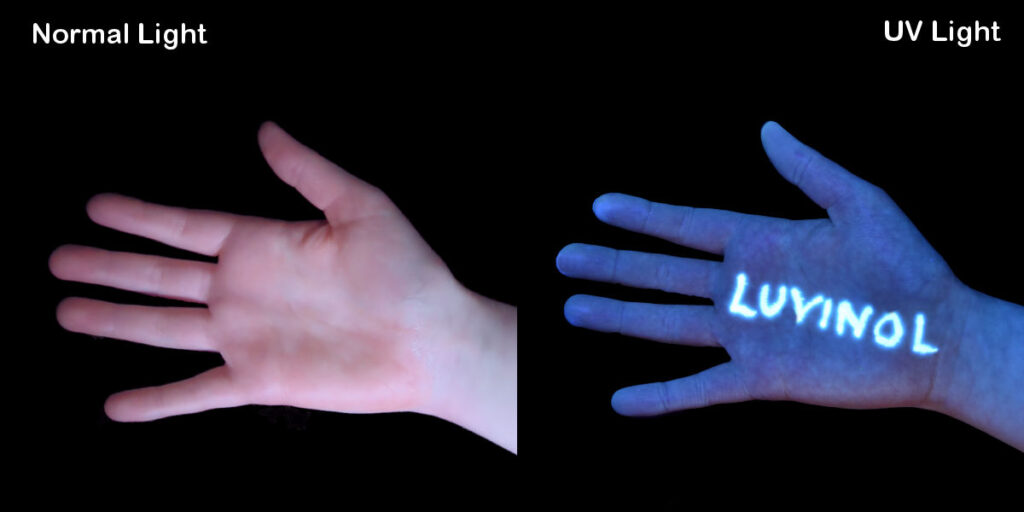
When a LUVINOL coated object (or surface) is touched, the skin is immediately stained with a temporary, invisible UV DYE which remains detectable on skin for at least 24 hours; even after intensive hand washing and showering!
However, when a UV Forensic torch is shown onto the hands, the invisible stain will be revealed, providing the indisputable ‘proof of contact’ you require.
LUVINOL will remain active until it is no longer required, where after it can be simply wiped clean and will not permanently stain or tarnish surfaces or fabrics like visible stains do!
LUVINOL Smart Gel is:
- Invisible
- Odourless
- Colourless
- Non-drying
- Easily cleaned
- Safe & Non-Toxic
- Non-Hazardous
- Non-Flammable
- Non-Tarnishing
- Non-Permanent
Use it on...
Coins • Banknotes • Jewellery • Stock items • Phones • Laptops • Alarm-Pads • Bicycles • Tools • Keys • Locks • Control Panels • Access Handles • Doorknobs • Lids etc.
In fact anything you need to know who has recently handled or used!
LUVINOL Compatability Note *
This Smart Detection Gel is a safe water based liquid. However, applying this to surfaces which are naturally water-resisting / water-rejecting (known as hydrophobic) means the LUVINOL may revert to small globules or rivulets rather than remain in a thin, even coating.
This characteristic is more likely to be seen on oil-painted or bare metal and plastic surfaces, but will not prevent LUVINOL from doing its job. However, if there is a downside to be aware of it is that the clear LUVINOL coating may become more visible on some surfaces, giving them a ‘wet’ appearance.
In some instances the LUVINOL Spray may be a better option, as it is able to lay down a fine dust-like layer of microscopic droplets which are less affected by this hydrophobic characteristic.
The lesson here is to test the possible ‘bait’ items in advance, to ensure the LUVINOL is compatible with the surface of the item(s). If for whatever reason you determine that LUVINOL is not suitable for use on any of the possible ‘bait’ items, then you can always revert to Theft Detection Powder as possibility.
This article may not be referenced, copied or reproduced without express persmission of GLOWTEC LTD. ©Copyright 2026
UV DYETECTIVE and LUVINOL brands are trademarks of GLOWTEC LTD ©Copyright 2026